According to several estimates, the AI buildout is now the largest investment boom in the history of the U.S., dwarfing the late 19th century railroad boom. We examine the implications across financial markets, GDP growth, inflation, and employment based on market performance and data received in October.
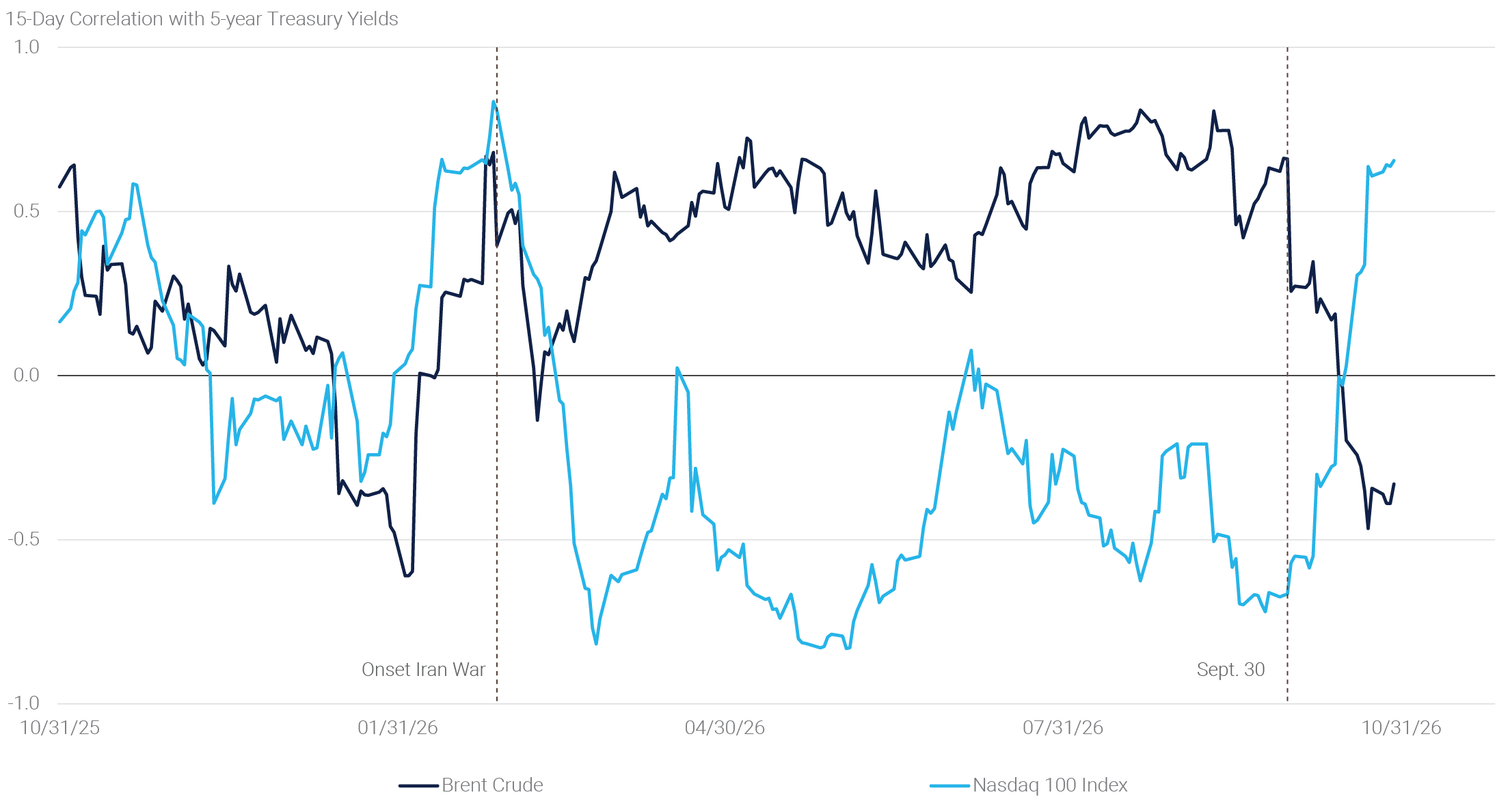
Taking direction from the old adage “what goes up, must come down,” interest rates reversed the selloff experienced in the latter part of last month, as demonstrated by the 10-year Treasury rallying 36 basis points (“bps”) in October. The yield curve flattened as short-term yields saw smaller declines amid a broadly unchanged economic backdrop. Importantly, while changes in interest rates had been positively correlated with oil prices for much of 2026 given the conflict in the Middle East, that correlation changed meaningfully in October. While oil prices marched higher on the month, with December WTI Crude Oil futures rising 18%, changes in interest rates are now much more closely correlated with equity prices (see panel 1).
Panel 1:
Stocks Take Baton from Oil as Driver of Interest Rates
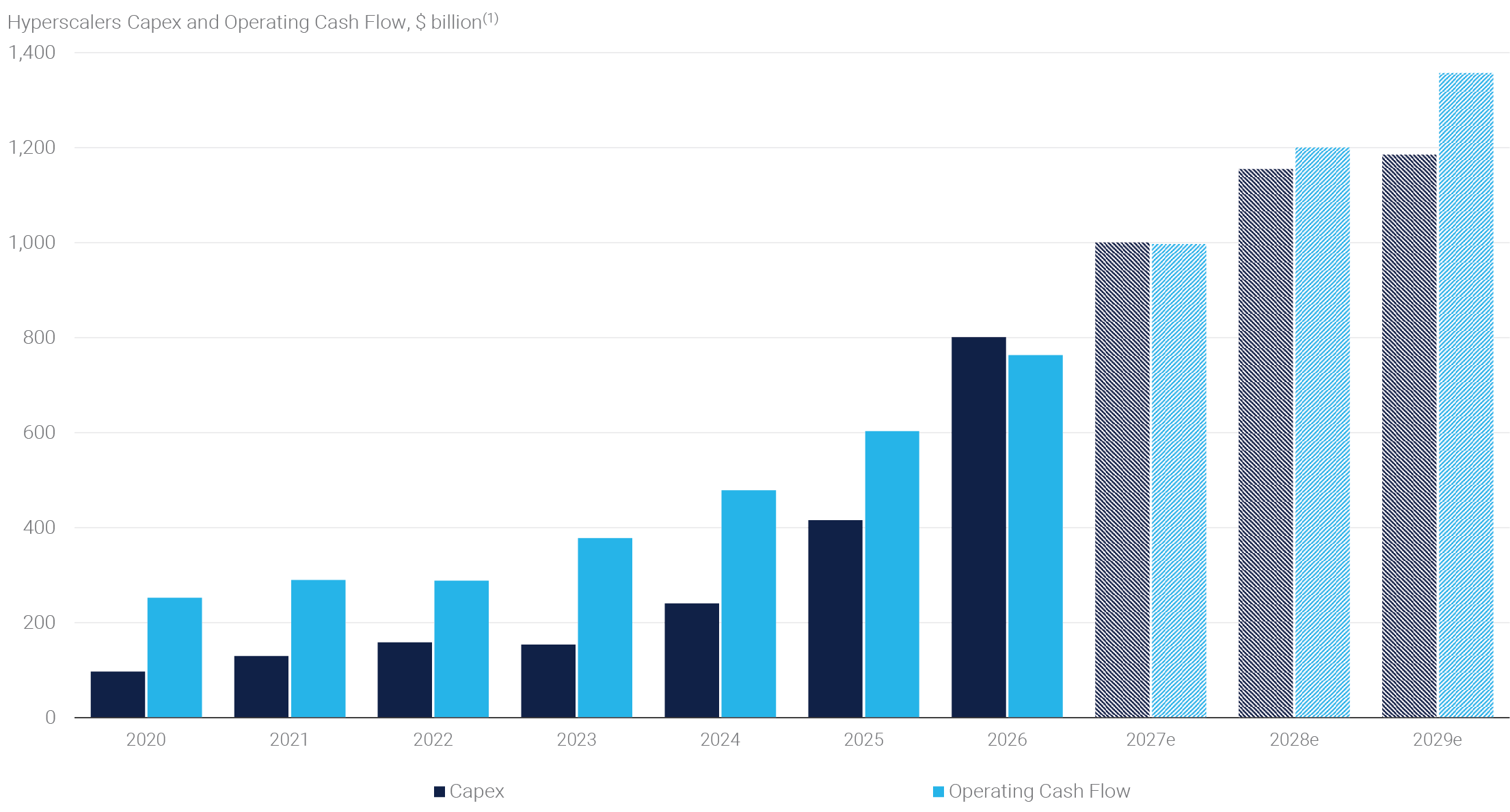
One driver of the rally in interest rates has been the growing concern about the efficacy of AI investments. Investments have become sufficiently large that firms are increasingly turning to debt and equity issuance as financing methods. In recent years, large technology companies were in the fortunate position to fund investments from their strong operating cash flows. However, based on their earnings reports and guidance, this is no longer the case this year (see panel 2). This historically large incremental capital issuance has pressured corporate bond spreads and absolute yield levels. Complicating the picture, many firms driving AI investment appear to be relatively insensitive to the level of interest rates, placing greater pressure on more rate sensitive sectors, such as housing or Treasury borrowing. While this may have added to the upward pressure yields faced in September, the impact seems to have reversed in October as investor sentiment shifted.
Panel 2:
More AI Capex, More Financing Needs, More Pressure on Debt Markets
Another driver appears to be the deterioration in European government bond markets, as French government bonds sold off sharply on a combination of factors surrounding the fiscal picture in the country. Burdened with a high debt load, a sizeable budget deficit, a presidential election in the spring of 2027, and public unrest, investors appear increasingly concerned that too little is being done to improve government finances and economic dynamism in one of the largest European economies. French 10-year bond yields widened 30 bps relative to their German counterparts in October, adding pressure to a 50-bps widening that took place in September, and reaching their widest levels since the depths of the European sovereign bond crisis in 2011. This deterioration has led to haven flows that boosted traditional safe assets like U.S. Treasuries.
Monetary Policy
Turning to U.S. monetary policy, the Federal Reserve (the “Fed”) kept interest rates unchanged in its October Federal Open Market Committee (“FOMC”) meeting, despite upgrading its assessment of economic growth and reaffirming its firm commitment to getting inflation back to target. Absent a meaningful deterioration in economic data or financial conditions, we continue to expect a 25-bp rate hike in December. The majority of the FOMC remains concerned about inflation, perhaps best evidenced by Governor Lisa Cook being one of two members voting against holding rates unchanged at the meeting. Through her dissent, Governor Cook signals that traditional moderate FOMC members might be more concerned about the inflation trajectory and might prefer to tighten policy further. Unlike all prior dissents during Chair Warsh’s at tenure, which have come from regional Fed Presidents that will not vote on policy next year, Cook has a permanent vote.
Of note, Chair Warsh announced that the FOMC will alter the structure of meetings going forward, with one meeting in 2027 and two meetings in 2028 being reserved for strategic deliberations. These meetings will not carry a statement and presumably not lead to changes in monetary policy. This effectively reduces the number of “live” FOMC meetings starting next fall for the first time since 1981, when the number of meetings was reduced from 12 to eight. Although details remain limited, we assume the first “strategy” meeting in this changed structure is likely to take place in October 2027.
Agency MBS & Risk Asset
Agency MBS performance improved in October relative to September, with the Bloomberg US MBS Index generating 48 bps in excess return during the month. Given the change in interest rate narrative, current coupon Agency MBS spreads tightened modestly, though elevated interest rate volatility prevented spreads from returning to levels seen before the September selloff. Note that implied and delivered interest rate volatility remained elevated in October, despite the reversal in rates. The continued elevated volatility appears to reflect the persistence of sizable daily interest rate moves over the last few months. For example, the 10-year Treasury yield moved more than 10 bps day-over-day on four days in September and October, compared to just three such moves in the first eight months of the year.
Risk assets had a mixed month, with the S&P 500 Index delivering a -0.9% total return on the month, as the aggregate index was weighed down by technology stocks. Of note, Q3 earnings have remained robust thus far, with S&P 500 aggregate earnings growth tracking nearly 30% year-over-year (“yoy”), a continued healthy read on corporate profitability. However, several large technology companies disappointed in earnings releases towards the end of the month, though not necessarily on factors directly related to the AI buildout.
The U.S. Economy
Strong consumer spending and extraordinary business investment continued to buoy the U.S. economy despite elevated inflation, geopolitical uncertainty, and high interest rates. That said, the most recent data appears to describe a two-speed expansion. Households continue to spend, albeit unevenly, while businesses continue to deploy capital at a vigorous pace. With the Fed expected to hike two to three more times by mid-2027, the central question for policymakers is whether the AI buildout is a productivity story that ultimately restrains inflation or a demand shock that adds to it. Data received in October point to the latter in the near term, as companies spend aggressively on data centers, software, information-processing equipment, semiconductors, electricity generation, and supporting infrastructure.
Economic Growth
October's growth-related releases reinforced the view that economic activity accelerated in Q3. The Bureau of Economic Analysis’ (“BEA”) advance estimate of Q3 GDP showed an economy that grew at a better-than-expected 3.4% seasonally adjusted annualized growth rate (“SAAR”) with real final sales to private domestic purchasers coming in at 4.9% SAAR, both of which represent a notable step up from the second quarter’s pace.
Consumer spending grew at a 3.8% SAAR pace for a second consecutive quarter with households proving more resilient than many economists expected given the squeeze from higher energy prices. Nevertheless, consumer fundamentals appear increasingly fragile aside from a still robust wealth effect associated with the AI boom. Thus, household demand may be more vulnerable than the headline data implies with spending strength varying significantly by income cohort. The September personal income and outlays report reinforced this view, with inflation-adjusted personal spending essentially flat on the month. Furthermore, the savings rate dropped to its lowest level in nearly four years while purchasing power continued to face pressure from elevated inflation. Total real disposable incomes fell in the month and are now growing at an anemic 1.0% annual rate.
Business investment, however, remained exceptionally strong, reinforcing its position as the defining economic story of 2026. Third quarter business investment grew at a whopping 19.4% SAAR, with equipment and software investment posting particularly strong gains. While the associated funding issues have weighed on the bond market, a key question is whether the “winner takes all/most” nature of the race between individual companies implies that a portion of aggregate investments will ultimately fail to generate the expected returns. The AI buildout also risks turning the economy into a one-trick-pony, a pattern somewhat reminiscent of the Dutch disease, the situation in which a boom in one sector crowds out the rest of the economy. To illustrate the latter point, look no further than the construction sector, where all of the yoy growth in real construction spending can be attributed to data centers and related power infrastructure.
Panel 3:
Aggregate Trade Balance Little Changed but Composition Very Different
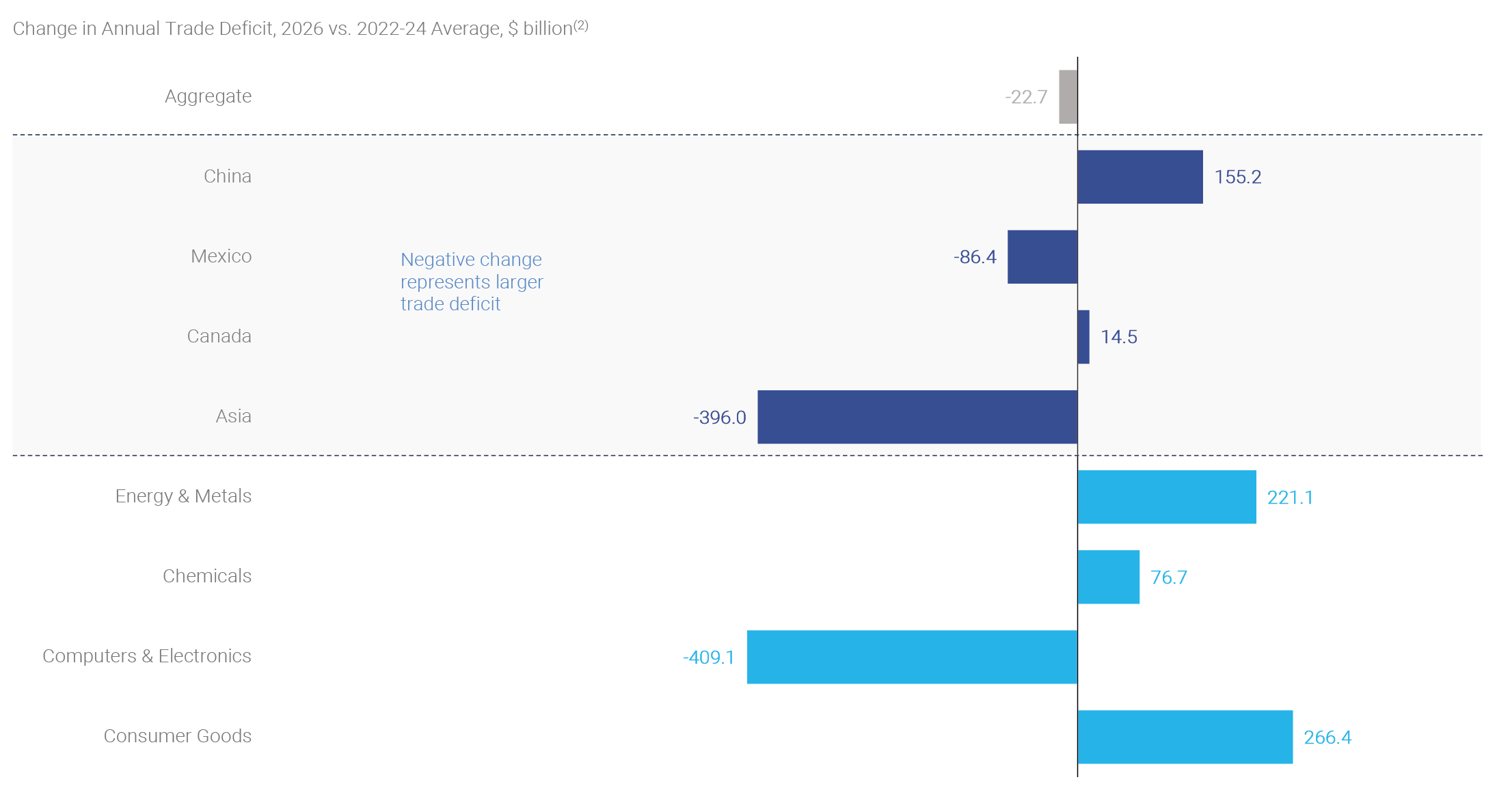
Relatedly, the growth impulse from the buildout is leaky given that a large portion of the business investment goes to imported goods that then subtract from GDP. Consequently, we would argue that the buildout’s “effective” growth contribution is likely much smaller than the headlines imply. Case in point, the August trade deficit widened to $105.6 billion, the largest since March 2025, as imports reached a record $420.8 billion. AI-related capital goods (computers, computer accessories, semiconductors, and telecommunications equipment) were the leading driver and were up $273 billion year-to-date, significantly more than the $107 billion rise in total goods imports. Moreover, according to the BEA’s trade balance report, comparing this year’s trade deficit to the 2022-24 average (see panel 3), one can clearly see that while the aggregate trade deficit is little changed, the composition at a country and product level looks very different with the AI buildout once again at the center of those trade dynamics.
Inflation & Labor Market
Inflation remains the dominant macroeconomic concern, with reports received in October coming in ahead of expectations. While energy prices continue to play a major role in the inflation story, recent data suggest that price pressures have broadened beyond fuel and transportation costs and are no longer isolated to a handful of categories. At the same time, a second inflationary force has become increasingly visible: the AI investment boom appears to be creating localized bottlenecks across the economy. According to the consumer price index report, prices for computers, peripherals, and smart home assistants rose 3.5% in July, 3.8% in August, and 1.4% in September (9.7% yoy). Electricity prices are up 4.4% yoy alongside the surge in utility output, and private capital equipment producer price index rose 0.8% in September. The broader implication is that inflation increasingly reflects demand-side strength driven by the AI buildout rather than temporary supply shocks alone. And while these price pressures remain far smaller than those associated with energy markets, they nonetheless represent another source of inflationary momentum at a time when the Fed keeps struggling to bring inflation back to target.
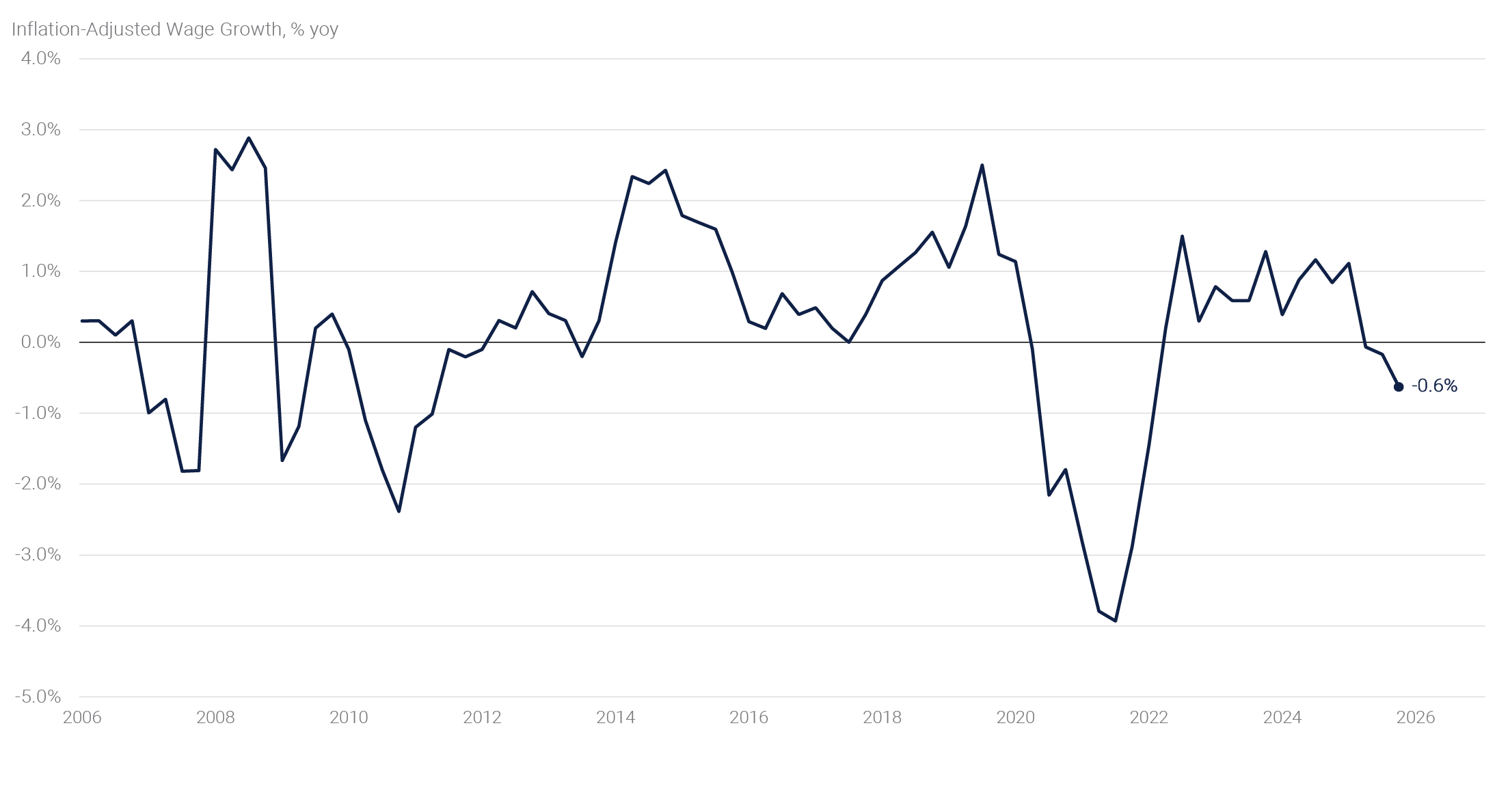
Meanwhile, labor market data received in October came in below expectations, but the broader narrative remained one of stability. That is, employers are reluctant to reduce headcounts aggressively, preserving the "low-hire, low-fire" environment that has characterized much of 2026. Notably, the unemployment rate has held in a 4.1%-4.3% range since March. Perhaps more importantly, wage growth has moderated without a corresponding deterioration in employment. The Fed’s preferred employment cost gauge, the Employment Cost Index (“ECI”), showed that total compensation grew at a 3.1% yoy pace in Q3 – a notable slowdown from the 3.5% and 3.9% pace achieved one and two years ago, respectively. That said, adjusting for inflation highlights the growing pressure on household purchasing power, with real wages down 0.6% yoy in Q3 (see panel 4). Overall, moderating wages and a stable labor market should give policymakers some confidence that the labor market remains in rough balance and is not an additional source of inflationary pressures.
Panel 4:
Falling Real Wages Should Limit Future Consumer Spending
However, continued strength in AI-driven investment may complicate that adjustment process even if thus far the adoption appears to be reshaping the composition of the labor market more than the aggregate number of jobs. Building data centers requires construction workers, engineers, and skilled tradespeople. Expanding cloud-computing networks calls for software developers, technicians, and infrastructure specialists. Rising electricity demand has boosted investment and hiring across portions of the utility and energy sectors. Thus, the AI buildout is creating meaningful labor demand in some areas even as other parts of the economy slow. While concerns persist regarding the long-term labor market implications, the near-term impact has been mixed with the fastest AI adopting industries shedding jobs, while sectors associated with the buildout continue to add them.